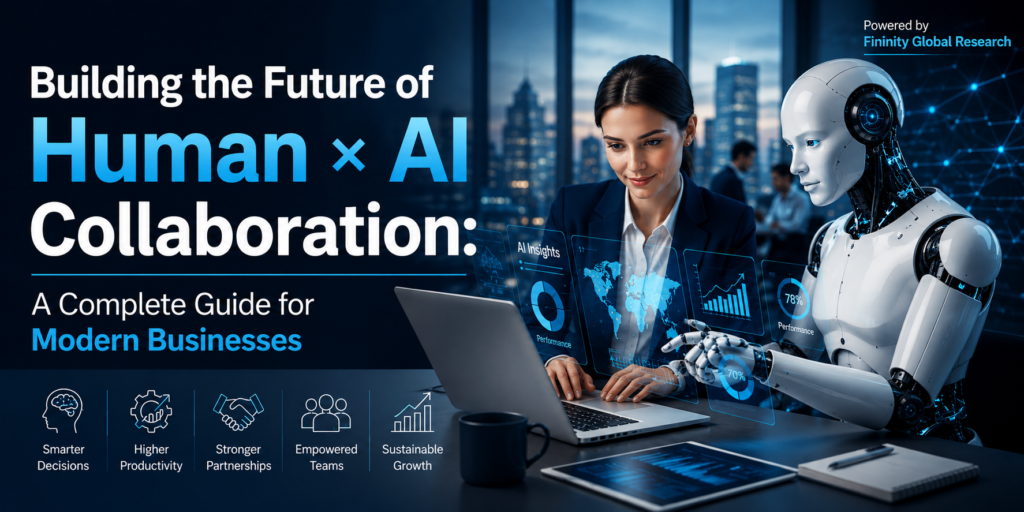
Building the Future of Human × AI Collaboration
Artificial intelligence has become one of the most discussed technologies in business, yet many organizations still approach it with the wrong mindset. The conversation often revolves around a single question: Will AI replace people? In reality, leading companies are asking a different question entirely—How can people and AI create more value together?
The businesses gaining a competitive advantage are not treating AI as a replacement for human expertise. Instead, they are redesigning workflows so that technology handles repetitive analysis while people focus on strategy, creativity, critical thinking, relationship building, and decision-making. This shift represents the evolution from automation to collaboration.
Human × AI collaboration is not about giving machines more responsibility. It is about allowing employees to spend more time solving meaningful problems while AI accelerates research, identifies patterns, reduces manual effort, and provides decision support. Organizations that understand this balance are improving productivity without sacrificing innovation, trust, or customer experience.
This guide explores how modern businesses can build an effective Human × AI collaboration strategy, where the greatest business value is created, the common implementation mistakes to avoid, and what leaders should prepare for over the next five years.
Why “Human × AI Collaboration” Is Replacing “AI vs Humans”
For years, discussions around artificial intelligence focused on competition. Headlines predicted widespread job losses, fully autonomous organizations, and machines replacing human workers. While AI has transformed many processes, experience across industries has shown that technology delivers the strongest outcomes when combined with human judgment rather than replacing it.
Artificial intelligence excels at processing enormous volumes of information in seconds. It can recognize patterns, summarize documents, automate repetitive tasks, and generate recommendations faster than any individual. However, AI still lacks the contextual understanding, ethical reasoning, emotional intelligence, and business intuition that experienced professionals develop over years of practice.
Consider a legal team reviewing contracts. AI can rapidly identify clauses, compare versions, and highlight potential risks. Yet deciding whether a clause aligns with business objectives, negotiation strategy, or long-term partnerships still requires human expertise. The same pattern appears across healthcare, finance, software development, education, and customer service.
The most successful organizations therefore no longer measure AI by how many people it replaces. They measure it by how much better people perform with AI supporting them.
This shift changes the role of technology. AI becomes a collaborative partner that increases speed and consistency while employees remain responsible for interpretation, accountability, creativity, and strategic direction.
The Three Levels of Human–AI Collaboration
1. AI as an Assistant
The first level focuses on improving individual productivity. AI helps professionals complete routine work more efficiently by drafting content, summarizing meetings, organizing information, searching knowledge bases, or generating first drafts.
In this stage, people remain fully responsible for decisions while AI reduces administrative effort. Employees spend less time gathering information and more time evaluating it.
For many organizations, this represents the fastest path to measurable productivity improvements because it requires minimal changes to existing workflows.
2. AI as a Decision Support System
As organizations mature, AI becomes part of operational decision-making. Instead of simply generating information, it analyzes trends, predicts outcomes, detects anomalies, and provides recommendations.
Examples include:
- Forecasting customer demand
- Predicting equipment failures before they occur
- Identifying financial risks
- Prioritizing sales opportunities
- Detecting cybersecurity threats
At this stage, humans remain accountable for final decisions. AI expands visibility by processing more data than any team could analyze manually, but business leaders still provide context and strategic judgment.
3. AI as a Collaborative Business Partner
The highest level of collaboration integrates AI directly into everyday business operations. Rather than functioning as a separate tool, AI becomes part of product development, customer engagement, operations, marketing, and innovation.
Teams continuously interact with AI systems that recommend actions, automate workflows, personalize customer experiences, and generate insights in real time.
Organizations operating at this level no longer think of AI projects as isolated initiatives. Human expertise and intelligent systems become interconnected parts of one operating model.
Where Businesses Create the Most Value
Many organizations invest heavily in AI technology but fail to achieve meaningful business outcomes because they automate low-impact activities. Sustainable value comes from improving decisions rather than simply accelerating existing processes.
Customer service is one of the strongest examples. AI can answer common questions instantly, categorize support requests, and suggest responses for service agents. Customers receive faster resolutions while human representatives dedicate their attention to complex situations requiring empathy and negotiation.
Marketing teams also benefit significantly. AI analyzes campaign performance, audience behavior, and market trends, enabling marketers to spend more time developing creative strategies instead of manually compiling reports.
Software engineering teams use AI to generate code suggestions, identify vulnerabilities, automate testing, and improve documentation. Developers remain responsible for architecture, security, and product quality while AI reduces repetitive development tasks.
Across finance departments, AI accelerates reconciliation, fraud detection, forecasting, and reporting. Financial professionals then focus on planning, risk management, and investment decisions rather than repetitive spreadsheet work.
The greatest business value consistently appears where AI enhances human expertise instead of replacing it.
Common Mistakes Organizations Make
Many AI initiatives fail not because of technology limitations but because organizations underestimate the importance of people.
The first mistake is adopting AI without defining a business objective. Purchasing advanced AI tools does not automatically improve productivity. Every implementation should begin with a measurable business challenge rather than the technology itself.
The second mistake is expecting immediate transformation. Successful adoption happens gradually through experimentation, employee training, and continuous refinement.
Another common issue is excluding employees from implementation decisions. When AI is introduced without transparency, teams often perceive it as a threat instead of an opportunity. Involving employees early builds trust and encourages adoption.
Organizations also underestimate governance. AI systems require clear policies covering data quality, privacy, security, compliance, and accountability. Without governance, even technically successful AI projects can create operational and reputational risks.
Building an AI-Ready Organization
Becoming AI-ready is less about purchasing sophisticated technology and more about developing organizational capability.
Leadership should begin by identifying workflows where employees lose time performing repetitive tasks. These processes often provide the quickest return on AI investment because improvements are immediately measurable.
Training is equally important. Employees should understand both the strengths and limitations of AI systems. Rather than expecting every employee to become an AI engineer, organizations should help teams learn how to collaborate effectively with intelligent tools.
Building cross-functional AI teams also accelerates adoption. Technology specialists, business leaders, legal experts, operations teams, and end users should participate throughout implementation. This ensures AI solutions address genuine business needs instead of isolated technical objectives.
Finally, organizations should treat AI as an ongoing capability rather than a one-time deployment. Continuous learning, governance, performance measurement, and user feedback allow AI systems to improve alongside the business.
Key Takeaways
The future of business is not defined by humans competing against artificial intelligence. It is defined by organizations that combine human creativity, leadership, and ethical judgment with AI’s ability to process information at unprecedented speed.
Companies that embrace Human × AI collaboration are building more resilient operations, improving customer experiences, accelerating innovation, and enabling employees to focus on higher-value work. Technology alone is rarely the competitive advantage. The real advantage comes from designing organizations where people and AI continuously strengthen one another.
Frequently Asked Questions
What is Human × AI collaboration?
Human × AI collaboration is a working model where artificial intelligence enhances human capabilities instead of replacing them. AI handles data-intensive and repetitive work while people provide strategic thinking, creativity, and decision-making.
Can AI replace business leaders?
No. AI can provide insights and recommendations, but leadership requires vision, ethics, communication, and accountability—qualities that remain uniquely human.
Which industries benefit the most from Human × AI collaboration?
Healthcare, finance, manufacturing, retail, software development, education, legal services, logistics, and professional consulting all benefit from combining AI automation with human expertise.
How should businesses begin their AI journey?
Organizations should start with clearly defined business challenges, identify repetitive workflows, train employees, establish governance policies, and scale successful AI initiatives gradually instead of attempting enterprise-wide transformation all at once.